

Where and how you mount your outdoor TV has a bigger impact on your experience than most buyers realize. The wrong placement means glare at the wrong time of day, uncomfortable viewing angles for half your guests, or a mount that fails after one rainy season.
These are the five most practical outdoor TV mounting setups -- what each one works best for, and what to watch out for.
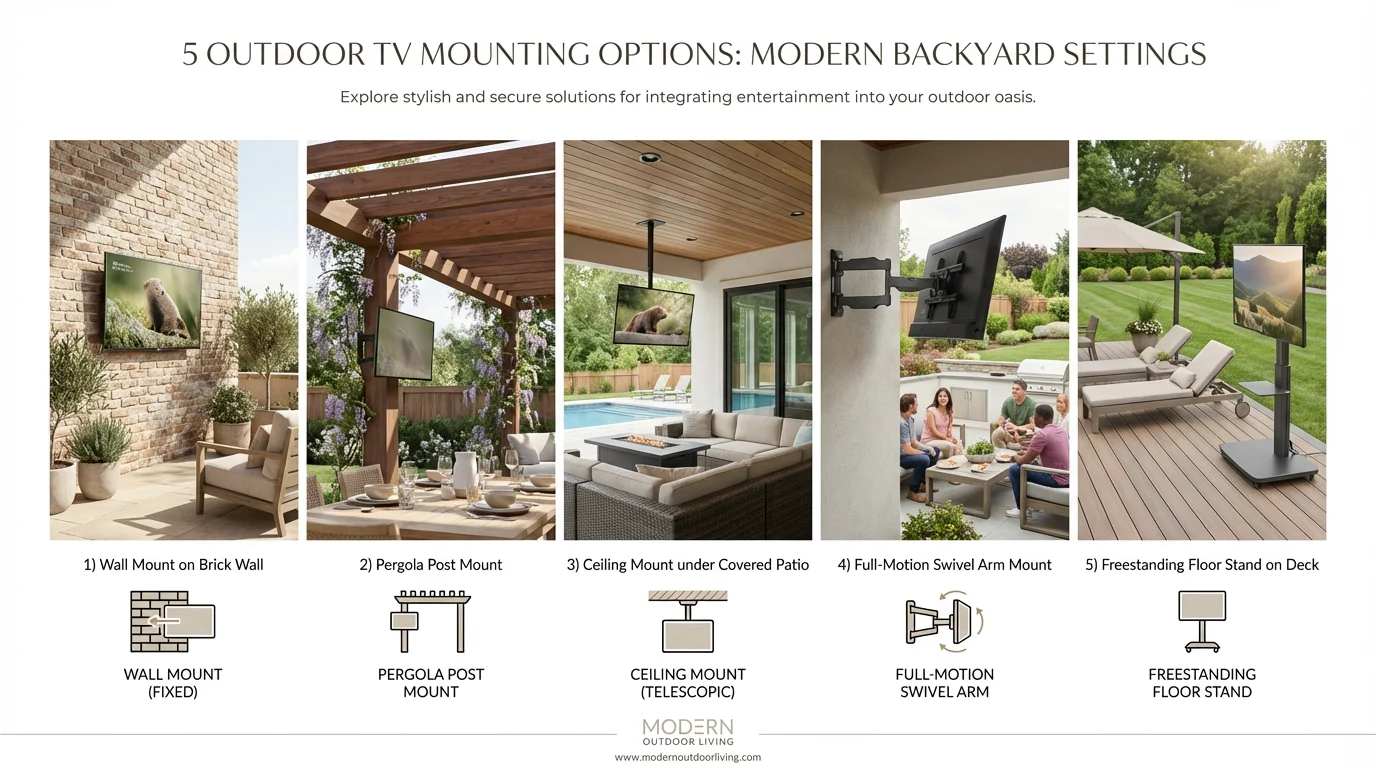
1. Wall Mount (Most Common)
Best for: Covered patios, outdoor kitchens, exterior house walls
A wall mount is the cleanest solution when you have a solid vertical surface -- brick, concrete, or a stud-backed exterior wall. It keeps the TV at eye level, hides cables inside the wall cavity, and positions the screen out of reach of foot traffic.
Mount types to consider:
- Fixed mount: lowest profile, most secure, no angle adjustment. Best when your seating is directly in front and at the right height.
- Tilt mount: lets you angle the screen down 5-15 degrees. Useful if the TV is mounted higher than ideal -- common on exterior walls where you're avoiding windows or doors.
- Full-motion (articulating) mount: swivels and extends on an arm. Lets you redirect the screen toward different seating areas or fold flat against the wall when not in use.
What to watch out for: Make sure the wall can handle the load. A 55" outdoor TV weighs 40-60 lbs. Stucco and wood siding without studs behind them are not sufficient anchoring points -- you need to hit solid masonry or framing.
2. Pergola or Post Mount
Best for: Freestanding pergolas, square or round posts, detached patio structures
If you don't have a wall nearby, a post mount clamps directly onto a pergola beam or vertical post -- no drilling into the house required. Brands like ZeboZap make clamp-style mounts that wrap around square posts (typically 3.5" to 6" wide) without permanent hardware.
Advantages:
- No structural modification to the house
- Positions the TV in the center of an outdoor seating area rather than along a wall
- Many post mounts include a 360-degree swivel so the screen faces any direction
What to watch out for: Check the post's load rating. Decorative pergola posts are often hollow or lightweight -- they may not support a large TV safely in wind. For anything over 55", verify the post material and width before buying a mount.
3. Ceiling Mount (Under a Covered Patio)
Best for: Covered patios with solid overhead structure, outdoor rooms, screened porches
A ceiling mount drops the TV down from a pole or arm attached to the ceiling joists. This works particularly well when wall space is limited or when you want the TV centered over the seating area rather than pushed to one side.
Advantages:
- Can position the TV exactly where the viewing angle is best regardless of wall layout
- Keeps the TV shaded by the roof structure, reducing glare
- Some ceiling mounts allow the screen to tilt or swivel for flexible positioning
What to watch out for: Ceiling mounts require a solid overhead joist or beam -- not just drywall or thin decking boards. The mount, pole, and TV combined can weigh 80+ lbs with movement forces added. Have the ceiling structure assessed before installation if you're unsure.
4. Full-Motion Swivel Arm (Wall or Post)
Best for: Multi-zone seating areas, L-shaped patios, spaces where the audience moves around
A full-motion mount attaches to a wall or post but extends on a jointed arm that can swivel left and right, tilt up and down, and extend forward from the surface. This is the most flexible option -- you can redirect the screen toward the dining table for dinner, then swivel it toward the lounge area for a movie.
What to watch out for: Arms add weight and leverage. A heavy TV on a long arm creates significant stress on the mounting point -- more so outdoors where wind adds load. Use a mount rated well above your TV's actual weight, and check it regularly for any loosening of hardware.
5. Freestanding Floor Stand
Best for: Renters, temporary setups, seasonal use, spaces where wall or post mounting isn't possible
A floor stand is a wheeled or fixed pedestal that holds the TV without any wall attachment. Some are designed to anchor into deck boards or paving stones for added stability.
Advantages:
- No installation required -- set up and move as needed
- Works on any flat surface: decks, patios, grass (with appropriate base)
- Easy to bring indoors during storms or off-season storage
What to watch out for: Wind stability is the main risk. A 55" TV on a freestanding stand acts like a sail in strong wind. Look for stands with a wide base and anchor points, and bring the TV inside when strong weather is forecast regardless of how secure it looks.
Sun Angle and Placement: The Overlooked Factor
Whichever mount type you choose, position the screen so it's not facing into the afternoon sun. The ideal orientation is:
- North or east-facing: the screen is in shade during peak afternoon brightness (when glare is worst)
- Under an overhang or shade structure: even partial overhead shading dramatically reduces glare
- Avoid south or west-facing: these orientations put the screen directly in the path of afternoon sun from spring through fall
Even a 1,500-nit outdoor TV will struggle with direct sunlight hitting the screen face-on. Placement matters as much as brightness rating.
Cable Management for Outdoor Mounts
Power and HDMI cables exposed to weather will fail. Plan for this before installation:
- Use outdoor-rated conduit (PVC or metal) to route cables along walls or posts
- Seal any wall penetrations with weatherproof silicone to prevent water ingress
- If running a new outdoor circuit, hire a licensed electrician -- a GFCI-protected outlet is required for outdoor installations in the US
- For TVs with built-in streaming (like Google TV), a single power cable may be all you need -- eliminating the HDMI run entirely
For a complete step-by-step installation walkthrough, see: How to Install an Outdoor TV: A Step-by-Step Guide
Who This Guide Is Not For
- Indoor installations: indoor mounts work fine inside; this guide focuses on outdoor-specific considerations
- Commercial or hospitality installs: high-traffic commercial environments have different load, vandalism, and weatherproofing requirements beyond the scope of a residential guide
Final Thought
The best mount is the one that puts the screen where your guests naturally look -- not where the wall happens to be. Spend time mapping your seating layout and sun exposure before committing to a mount location. Moving a mount after the fact means filling holes and starting over.
If you're still deciding on the TV itself, see our outdoor TV backyard buying guide for what specs actually matter.

0 comments