

Before installing an outdoor TV, it is worth understanding what it will actually add to your electricity bill. The numbers are often smaller than people expect — but outdoor TVs do have some characteristics that set them apart from indoor panels when it comes to power draw.
How Much Power Does an Outdoor TV Use?
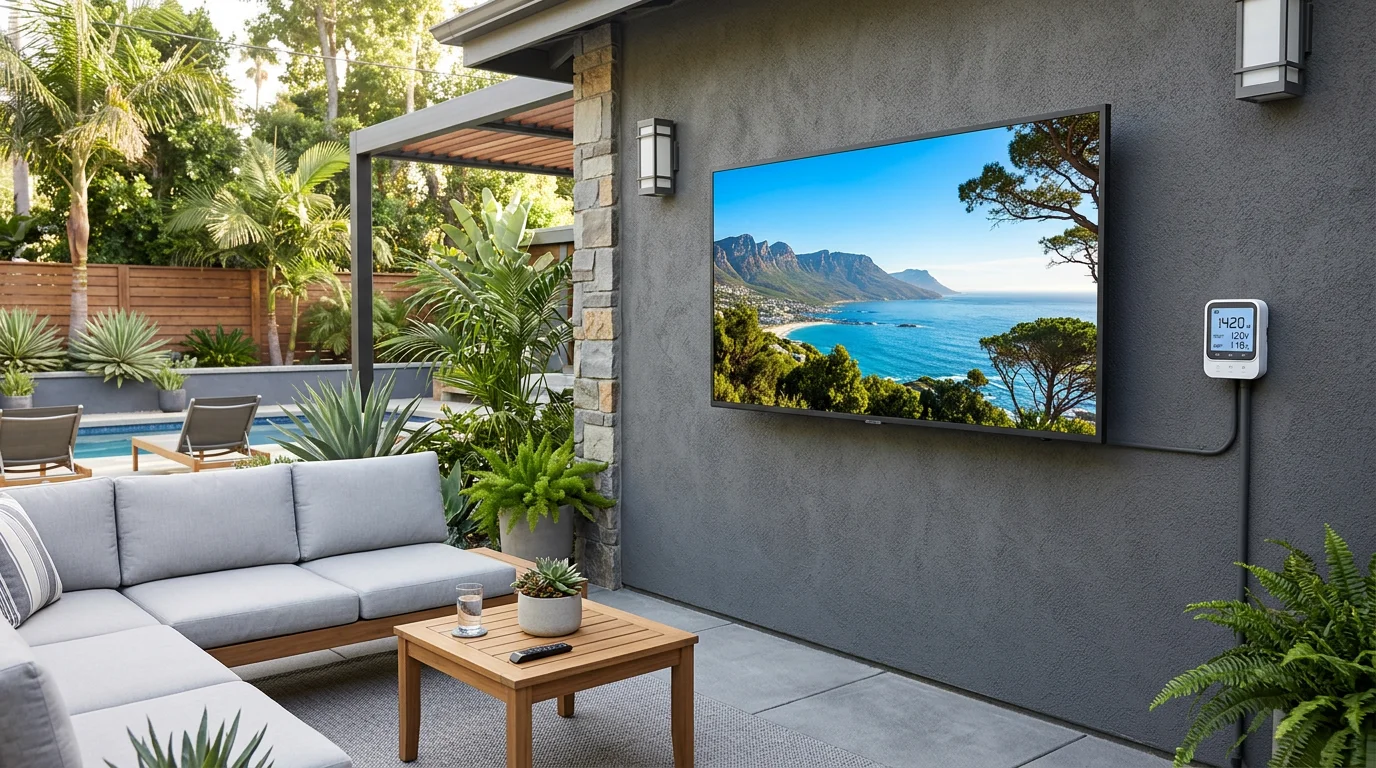
Power consumption for outdoor TVs varies primarily by screen size and brightness setting. Unlike indoor TVs, outdoor models are engineered for high-brightness output — and higher brightness means higher power draw. Here is a realistic range based on common outdoor TV specs in 2026:
| Screen Size | Typical Wattage (normal brightness) | Peak Wattage (max brightness) |
|---|---|---|
| 43" | 80 – 120W | 140 – 180W |
| 55" | 120 – 180W | 200 – 280W |
| 65" | 160 – 240W | 280 – 380W |
| 75" | 200 – 300W | 350 – 450W |
For comparison, a standard 55-inch indoor LED TV typically draws 80 to 120W at normal brightness — outdoor models run roughly 50 to 80% higher at the same size because of their elevated backlight output (source: energy.gov appliance energy guide, April 2026).
What It Actually Costs Per Month
Using the US average electricity rate of approximately $0.16 per kWh (source: U.S. Energy Information Administration, 2026), here is what a 55-inch outdoor TV costs to run at typical usage:
- 4 hours/day, 5 days/week: ~$1.40 – $2.10/month
- 6 hours/day, 7 days/week: ~$3.00 – $4.50/month
- Running parties and events (20 hours/month total): ~$0.70 – $1.10/month
Even at heavy outdoor use — daily evening viewing during summer months — most homeowners add $3 to $5 per month to their electricity bill. This is not a meaningful budget concern for most households.
Standby Power Draw
Most modern outdoor TVs draw 0.5 to 2W in standby mode. At $0.16/kWh, leaving a TV in standby continuously costs roughly $0.70 to $2.80 per year — negligible. If you want to eliminate standby draw entirely, a smart outdoor outlet with a timer is a simple solution and also lets you schedule the TV's power on a set schedule.
Does Brightness Setting Significantly Affect Power Use?
Yes. Running an outdoor TV at maximum brightness versus 50% brightness can increase power draw by 40 to 60%. In full sun conditions, maximum brightness is necessary. In shade or evening use, reducing brightness to 60–70% delivers adequate image quality and meaningfully lowers power consumption. Most outdoor TVs include an ambient light sensor that adjusts brightness automatically — enabling this feature is the easiest way to balance picture quality and efficiency.
What Circuit Do You Need?
A 55-inch outdoor TV drawing up to 280W at peak requires a standard 15-amp circuit with margin to spare. You do not need a dedicated circuit unless you are running the TV alongside high-draw equipment on the same outlet (large outdoor speaker amplifiers, patio heaters, power tools). Standard outdoor GFCI outlets are sufficient and required by code for exterior installations in most jurisdictions.
Who Should Not Worry About This
For almost every homeowner, outdoor TV power consumption is not worth optimizing around. The monthly cost is comparable to leaving a few LED bulbs on. Focus your budget decisions on screen size, brightness rating, and weatherproofing — not on chasing a slightly lower wattage spec. The difference between a 150W and a 200W outdoor TV at your actual usage pattern is about $0.50 per month.
If you are planning a full outdoor entertainment setup, see How to Install an Outdoor TV for the complete installation walkthrough, and Do Outdoor TVs Need a Surge Protector for guidance on protecting your investment from power events.

0 comments