

Searching "outdoor TV vs projector" mostly returns vague advice that refuses to pick a side. This article does the opposite: it breaks down the actual numbers so you can make a clear decision before spending a cent.
The Setup Costs: What You Actually Pay
An outdoor TV is a single purchase. An outdoor projector is a system purchase. That distinction matters more than the sticker price on either device.
Outdoor TV total cost (55"):
- TV unit: $1,200 – $1,800
- Weather-rated wall mount: $80 – $150
- Outdoor-rated HDMI cable (if needed): $20 – $50
- Total: ~$1,300 – $2,000
Outdoor projector system total cost (120" image):
- Projector unit (3,000+ ANSI lumens): $500 – $2,500
- Fixed outdoor projection screen (120"): $200 – $600
- Projector mount or ceiling enclosure: $100 – $400
- Outdoor-rated power extension + surge protection: $50 – $120
- External speaker (projectors rarely have useful built-in audio): $150 – $500
- Total: ~$1,000 – $4,120
At the low end, a projector system can cost less. At the mid-range — where most buyers actually land — the gap narrows fast. And the projector system still has ongoing costs the TV does not.
The Brightness Problem: Why This Is the Decisive Factor
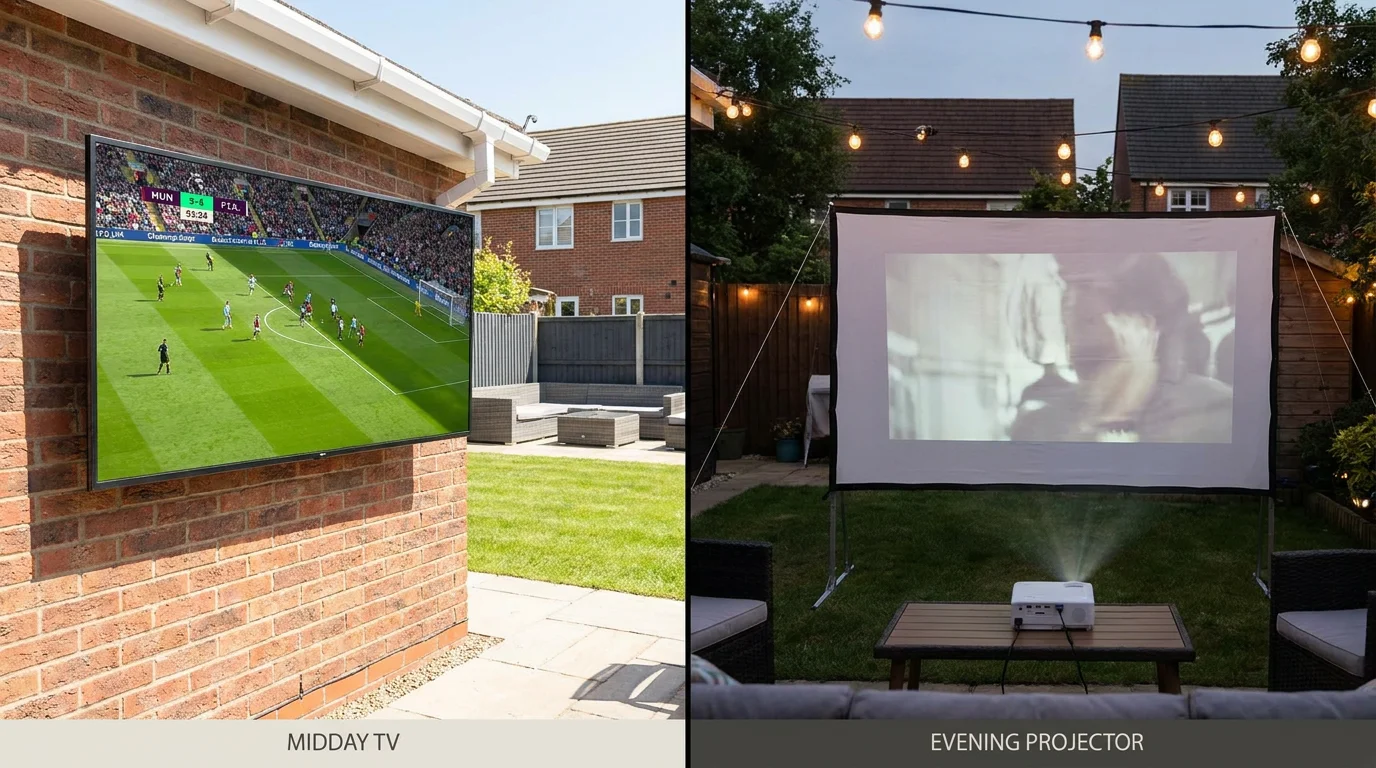
Outdoor TVs emit light directly from the panel — typically 1,000 to 2,000 nits depending on the model. Outdoor projectors reflect light off a screen. A 3,500-lumen projector projecting onto a 120" screen produces roughly 200 nits at the viewer's eye (source: tvsbook.com analysis, April 2026).
That is a 7x brightness difference in conditions where ambient light matters — meaning any time the sun is up, or even in a well-lit covered patio in the evening. The 200-nit image gets washed out. The 1,500-nit TV image does not.
This is not a brand quality issue. It is physics: reflected light cannot compete with emitted light under ambient illumination. A more expensive projector narrows the gap slightly — a 5,000-lumen laser projector produces about 300 nits on a 120" screen — but still falls far short of a mid-tier outdoor TV.
Ongoing Costs Over 5 Years
| Cost Item | Outdoor TV | Outdoor Projector |
|---|---|---|
| Lamp/LED replacement | None (panel-based) | $100 – $400 every 3,000–5,000 hrs (lamp models) |
| Screen replacement (wear/weather) | None | $150 – $400 (every 5–8 years) |
| External speaker | Optional (TV has built-in audio) | Usually required ($150 – $500) |
| Power consumption (8 hrs/week) | ~$30 – $50/year | ~$25 – $45/year (similar) |
| Estimated 5-year add-on cost | $150 – $250 | $400 – $1,300 |
Lamp-based projectors have the highest ongoing costs. LED and laser projector light sources last 20,000–30,000 hours and have no replacement cost, but those units start at $1,000+ for the projector alone.
Installation Complexity
Outdoor TV: Wall mount, HDMI run, power outlet. Most homeowners complete it in 3–5 hours. The TV handles everything — streaming OS, audio, image processing — in one unit.
Outdoor projector system: You need to determine throw distance (projector-to-screen distance for the desired image size), mount the projector at that precise point, align the image, run power to the projector location, mount or frame the screen, and add a separate audio system. Typical DIY time: 6–12 hours. If the projector is ceiling-mounted in a covered area, you also need to weatherproof the mount or buy a purpose-built outdoor enclosure.
The projector setup is not impossible — it just has more variables, more components to source, and more things that can go wrong.
Where Each One Wins
Outdoor TV wins for:
- Daytime or early-evening viewing in any ambient light condition
- Sports — TV handles fast motion and low input lag far better than most projectors
- Covered patios, pergolas, and partial-sun installations
- Permanent year-round installs where weatherproofing matters
- Buyers who want a simpler, single-unit setup
Outdoor projector wins for:
- Post-sunset-only use in genuinely dark environments (fully enclosed space with blackout walls)
- Buyers who specifically want a 120"+ image and are willing to accept ambient light limitations
- Occasional-use movie night setups that can be packed away after use
Who Should Not Buy an Outdoor TV
If your primary use case is a once-a-month movie night in a fully enclosed dark pergola where you want a 150" image, an outdoor TV is the wrong tool. A 75" TV in that scenario is simply too small for the cinematic experience you are after, and the projector's ambient light weakness will not matter because you control the environment completely. In that specific situation, a quality outdoor projector makes more sense.
The Bottom Line
For most residential outdoor setups — patios, decks, backyard areas with any ambient light, sports viewing, year-round use — an outdoor TV delivers better picture quality, simpler installation, lower 5-year total cost, and far better daytime performance than any projector system in a comparable price range.
The 7x brightness gap between a mid-tier outdoor TV (~1,500 nits) and a 120" projector setup (~200 nits) is the deciding factor. Projectors work beautifully after dark in controlled environments. They struggle everywhere else.
If you are considering a 55" outdoor TV for a partial-sun patio or covered deck, options like the ByteFree 55" Outdoor TV (1,500 nits, IP55, Google TV) are worth looking at as a starting point for comparison — though the right choice always depends on your specific space and viewing habits.
If you want more guidance on brightness requirements, see our article on How Many Nits Does an Outdoor TV Need. For questions about installation, How to Install an Outdoor TV walks through the full process.

0 comments