

The answer depends almost entirely on when and where you plan to watch — specifically, how much ambient light you're dealing with. An outdoor TV and an outdoor projector solve genuinely different problems. Buying the wrong one means either a screen that's invisible in afternoon light, or overpaying for brightness you never actually need.
This comparison covers the dimensions that matter: brightness and ambient light performance, image size, weather durability, cost, and which setup actually fits which use case.
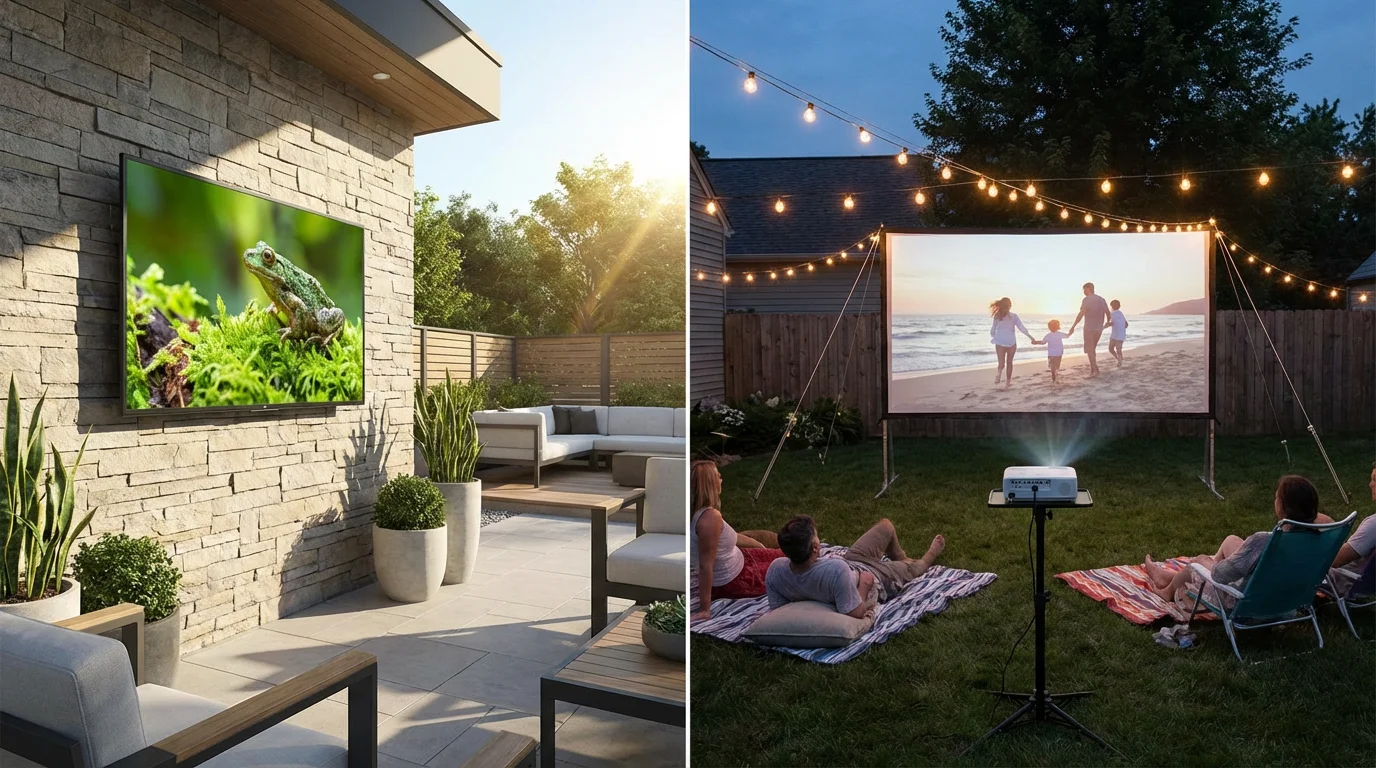
The Core Difference: How Each Technology Works
An outdoor TV is an emissive display — the screen itself produces light. This makes it inherently effective at fighting ambient light, since it's adding light to your field of view rather than requiring darkness to create contrast.
An outdoor projector is a reflective display — it bounces light off a screen surface. The projected image competes against any other light hitting the same surface. In bright conditions, ambient light washes out projected images far faster than it washes out an emissive TV screen.
This fundamental difference explains almost all of the tradeoffs below.
Brightness and Ambient Light Performance
This is the most consequential factor for most buyers.
Outdoor TVs are measured in nits. Consumer-grade outdoor TVs typically range from 400–700 nits. Purpose-built outdoor models start at 1,000 nits and go higher — the practical threshold for comfortable viewing in direct full-sun conditions is generally considered to be around 1,000–1,500 nits sustained (not peak). Peak brightness numbers from manufacturers are often 30–50% higher than sustained brightness, so sustained specs matter more for daytime use. Read the nits guide for a full breakdown.
Outdoor projectors are measured in lumens (ANSI or ISO). The relationship between lumens and usable outdoor performance:
- Under 1,000 lumens: Usable after dark only, or in a very shaded space with no ambient light
- 1,000–2,000 lumens: Works well at dusk and in shaded outdoor conditions
- 3,000+ lumens: Needed for low-sun or overcast daytime viewing in shade; still struggles in direct afternoon sun
- 5,000+ lumens: Required for bright daytime outdoor use — these are commercial-grade units, typically $2,000+
The practical summary: if you want to watch during the day or at times when there's still ambient light in the sky (early evening, dusk), a TV wins on visibility. If you only watch after dark, a projector is far more competitive.
Image Size
Projectors win here, clearly. A mid-range outdoor projector can project a 100–120 inch image at a fraction of the cost of a comparable-size outdoor TV. Most residential outdoor TVs top out at 75–85 inches — and prices rise steeply above 65 inches.
However, image size only matters if the image is actually visible. A 120-inch projected image that's washed out by dusk ambient light delivers less useful viewing experience than a sharp, bright 65-inch TV screen.
Weather Durability
Outdoor TVs designed for permanent outdoor installation carry IP ratings — IP55 being a common standard for residential use (dust-tight, protected against water jets). They're engineered to live outside year-round within their rated temperature range, with sealed ports and sealed enclosures.
Outdoor projectors vary widely. Portable outdoor projectors are designed for occasional use and carried in and out of storage — they're not built for permanent exposure. There are weatherproof projector enclosures for permanent outdoor installations, but they add cost and complexity. The projection screen itself is a separate durability consideration: permanent outdoor screens require weather-resistant frames and screen materials.
For a permanent installation that stays outside through the seasons, an outdoor TV is simpler. For occasional-use setups that are set up and put away, a portable projector is more practical.
Cost
Cost comparisons depend heavily on the use case and image size target:
| Setup Type | Typical Cost Range | Notes |
|---|---|---|
| Portable outdoor projector (1,000–2,000 lm) | $150–$600 | After-dark use only; screen sold separately ($80–$300) |
| High-lumen outdoor projector (3,000–5,000 lm) | $600–$2,500 | Needed for dusk/overcast daytime use |
| Entry outdoor TV (55", 500–700 nits) | $400–$900 | Usable in shade, not full sun |
| Purpose-built outdoor TV (55", 1,000–1,500 nits) | $1,200–$2,500 | Full-sun capable; permanent installation ready |
| Permanent outdoor projector system (4,000+ lm + weatherproof housing + screen) | $2,000–$6,000+ | Commercial-grade; larger image but complex install |
The cost curves cross at different points depending on image size and brightness requirements. For 55–65 inch viewing in variable light conditions, a quality outdoor TV is typically more cost-effective than a projector system with equivalent usable brightness. For 100-inch+ cinema setups used exclusively after dark, a projector system can be significantly cheaper.
Setup and Maintenance
Outdoor TVs require a one-time installation — wall mount, power run, and done. Ongoing maintenance is minimal: periodic hardware checks, screen cleaning. No setup required per viewing session.
Projectors (portable) require setup and takedown per session: positioning the projector, setting up the screen, adjusting focus and alignment. For permanent projector installations, the setup is one-time, but managing the projection distance and screen tension adds complexity.
If you entertain frequently and want a setup that's ready in seconds, an outdoor TV is significantly more convenient. If you watch occasionally and enjoy the ritual of setting up a proper outdoor cinema, a portable projector suits that pattern.
Audio
Both outdoor TVs and projectors have limitations on built-in audio outdoors. Built-in speakers on any device struggle to fill an outdoor space — ambient noise, open air, and distance all reduce perceived volume and clarity.
For either setup, an outdoor-rated soundbar or weatherproof Bluetooth speakers are typically a worthwhile addition. The difference: outdoor TVs usually have more mature HDMI ARC/eARC integration for external audio systems. HDMI 2.1 eARC allows audio pass-through at full quality to a connected soundbar — many projectors support ARC, but fewer support eARC, which matters for Dolby Atmos content. For the comparison of specific outdoor TV models, audio specifications are covered in the buyer's guide.
Who Should Choose an Outdoor TV
- You watch during daylight hours or early evening with ambient sky light
- You want a permanent installation that's ready instantly without setup
- Your primary viewing area is 55–75 inches and in a partially or fully sun-exposed location
- You need weather durability without managing a separate screen and enclosure
- You're integrating into a smart home ecosystem via Google TV, Apple TV, or similar
Who Should Choose an Outdoor Projector
- You watch exclusively after dark, in a fully shaded space, or under a dark-sky area
- You want a 100-inch+ screen at a cost below a large outdoor TV
- You watch occasionally (monthly or less) rather than regularly
- Portability matters — you want to bring the projector to different locations
- You specifically want the "outdoor cinema night" experience and are willing to set it up
Who Gets Neither Right Now
If your primary location is in deep shade and you watch after dark, a standard indoor TV in an outdoor TV enclosure may be sufficient — and significantly cheaper than either a purpose-built outdoor TV or a high-lumen projector. An enclosure protects the TV from moisture and physical damage, and in a shaded location, indoor TV brightness levels are adequate. This is a viable option if budget is the primary constraint.
Summary
The choice is simpler than it first appears:
- Sunlight or mixed light viewing → outdoor TV. No projector competes with a 1,000+ nit TV in daytime conditions at reasonable cost.
- After-dark only, large screen, occasional use → projector. A good projector at $500–$1,000 delivers a 100-inch image that a same-budget outdoor TV cannot match on screen size.
- Permanent, always-ready, full-sun setup → outdoor TV. A projector permanent install adds screen, housing, and alignment complexity that rarely makes sense for a home setup.
- Large screen + any ambient light → a projector gets expensive fast. Once you need 3,000+ lumens for daytime viewing, projector costs quickly exceed equivalent outdoor TV options.
If you're leaning toward an outdoor TV, the nits guide and buyer's guide cover how to match brightness specs to your specific install.
FAQ
Can a regular indoor TV be used as an outdoor projector screen?
No — a projector needs a flat, white, matte surface at the right distance for a focused, evenly lit image. An indoor TV can't serve as a projection surface.
How many lumens do I need to use a projector in a lit backyard?
For a bright evening with ambient sky light, 2,000–3,000 ANSI lumens is the minimum for a usable image. For afternoon or overcast-day viewing in shade, 3,000–5,000. Direct sunlight effectively requires 5,000+ lumens — at that level, a high-nit outdoor TV is typically a better value.
Does an outdoor TV work in the rain?
IP55-rated outdoor TVs are tested against water jets from any direction — they handle rain without damage. They're not submersion-proof (IP67/68 rating would be needed for that). Pool splash and rain are within spec; underwater immersion is not.
What size projector screen do I need for a backyard setup?
For casual backyard use at 10–15 feet viewing distance, 100–120 inches is a common target. The screen size you can achieve depends on the projector's throw ratio — check the manufacturer's throw distance chart for your specific model to match screen size to available space.

0 comments