

Choosing the wrong size outdoor TV is one of the most common mistakes buyers make. Go too small, and you squint from across the patio. Go too big, and the image looks soft up close.
The good news: there is a simple formula that takes the guesswork out of it.
The Core Formula: Viewing Distance Divided by 1.5
The most widely cited rule for 4K TVs (source: RTINGS.com):
Recommended screen size (inches) = Viewing distance (inches) / 1.5
So if you are sitting 10 feet (120 inches) away:
120 / 1.5 = 80 inches (upper end of the sweet spot)
120 / 1.6 = 75 inches (conservative estimate)
Both are valid -- the difference comes down to how immersive you want the experience to feel.
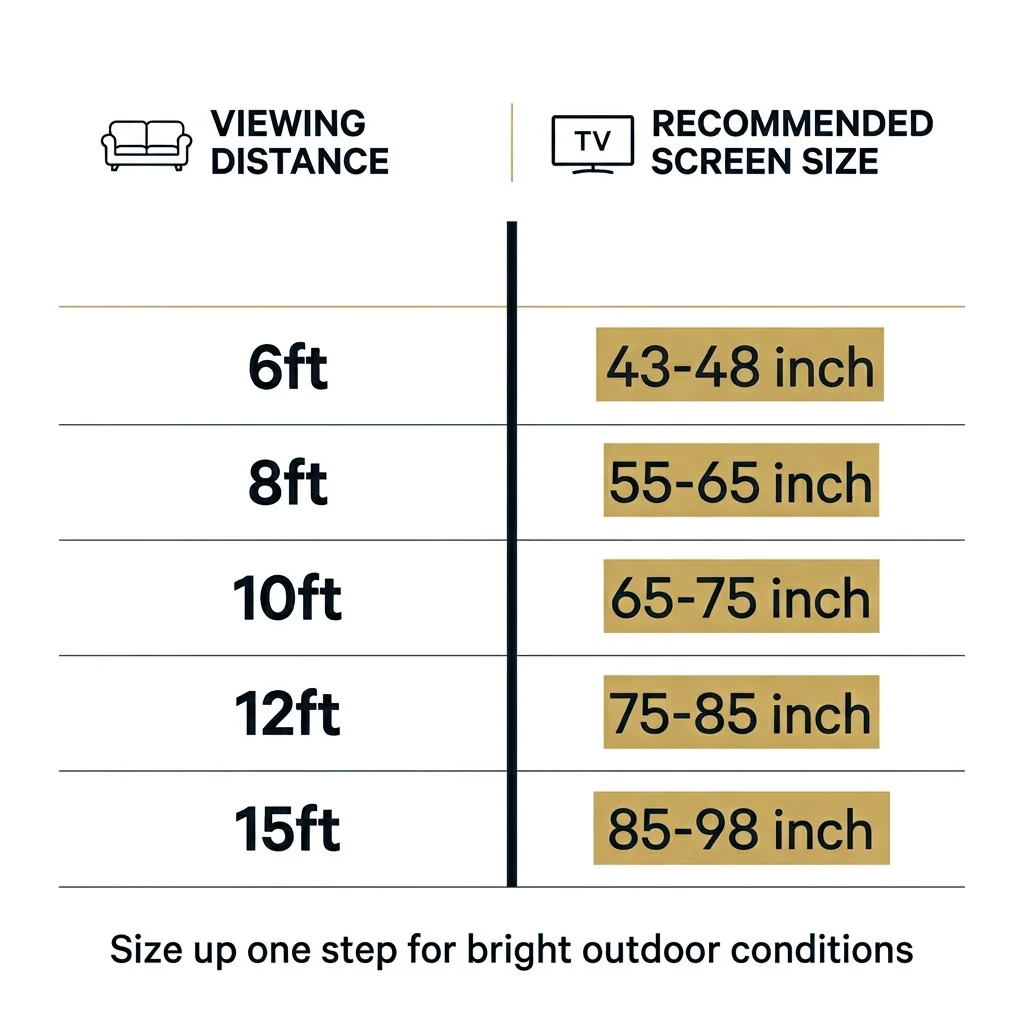
Quick Reference: Viewing Distance to Screen Size
| Viewing Distance | Minimum Size | Recommended Size |
|---|---|---|
| 6 ft (72") | 43" | 48" |
| 8 ft (96") | 55" | 65" |
| 10 ft (120") | 65" | 75" |
| 12 ft (144") | 75" | 85" |
| 15 ft (180") | 85" | 98" |
Why Outdoor Viewing Is Different From Indoors
Outdoors, you should generally size up compared to indoor recommendations. Here is why:
- Ambient light reduces perceived contrast -- a bright afternoon sun makes images look flatter and smaller, even at the same screen size
- Seating layouts are less predictable -- guests move around; some will be farther than your primary viewing spot
- Open space makes screens feel smaller -- without walls framing the image, the same 55" TV feels noticeably more compact outside than it does in a living room
A practical rule of thumb: if the formula says 55", consider 65" for outdoor use.
Scenarios: Which Size for Which Space?
Small covered patio or balcony (6-8 ft viewing distance)
43"-55" works well. Compact enough to mount on a wall or post without dominating the space.
Standard backyard patio (8-12 ft viewing distance)
55"-65" is the sweet spot for most households. Large enough for group viewing, manageable for permanent mounting.
Large backyard or poolside (12-18 ft viewing distance)
75"-85" recommended. At 15 ft or more, anything under 75" will feel undersized for sports or movies.
Dedicated outdoor theater or entertaining area (18 ft+)
85"-98" or a commercial-grade display. At this size and distance, brightness (nits) matters as much as physical size.
The Brightness Factor: Why Size and Nits Work Together
A common mistake: buying a large screen but skimping on brightness.
Outdoor TVs need a minimum of 1,000 nits to stay visible in partial shade. In direct sunlight, you need 1,500+ nits for a watchable image. A 75" TV at 500 nits will look worse than a 55" TV at 1,500 nits on a sunny afternoon.
If you want to understand the nits spec in depth, see our guide: How Many Nits Does an Outdoor TV Need?
Who This Guide Is Not For
- Indoor use: the formula above is calibrated for outdoor environments; indoor viewing can generally go one size smaller
- Covered garage or barn setups with controlled lighting: treat these spaces like an indoor room -- divide by 1.6 instead of 1.5
- Buyers prioritizing portability: if you move your TV seasonally, a smaller screen with a weatherproof cover may be more practical than maximizing size
Final Recommendation
If you are still unsure, 55" is the most versatile starting point for a standard American backyard patio. It covers 8-10 ft viewing distances comfortably, fits standard mounts, and is the most available size in purpose-built outdoor TV models.
If your primary viewing distance is 12 ft or more, step up to 65" or 75".
One option worth considering if you are looking at 55" outdoor TVs: the ByteFree 55" Outdoor TV delivers 1,500 nits peak brightness with IP55 weatherproofing and Google TV built in -- a combination that is hard to find under $1,600. It also covers the best 55-inch outdoor TVs of 2026 if you want to compare options side by side.

0 comments