

Glare is the most common complaint from outdoor TV owners — and it is almost always a solvable problem, usually without buying new equipment. Understanding what actually causes glare helps you address it at the source rather than accepting a washed-out picture as inevitable.
What Causes Glare on an Outdoor TV
Outdoor TV glare has two distinct causes that are often confused:
1. Ambient light overwhelming the panel's brightness. When direct sunlight hits the viewing environment — your eyes, the surrounding surfaces, or the content you are trying to see — even a 1,500-nit panel struggles to compete. This is a fundamentally different problem from reflection.
2. Specular reflection from the screen surface. Light sources behind or beside the viewer (the sun, sky, patio lights) reflect off the screen glass back toward the viewer's eyes. This is what most people mean when they say "glare" — a visible reflection of a light source on the screen.
The fixes for each are different. Most guides lump them together, which is why many suggested solutions work in one situation but not the other.
Fix 1: Address the Viewing Angle and Sun Position
The most effective — and free — solution for reflection-based glare is to adjust the TV's horizontal or vertical angle so the primary light source (the sun) no longer falls at the reflection angle toward your seating position. A tilt mount or full-motion swivel mount lets you make this adjustment as the sun moves.
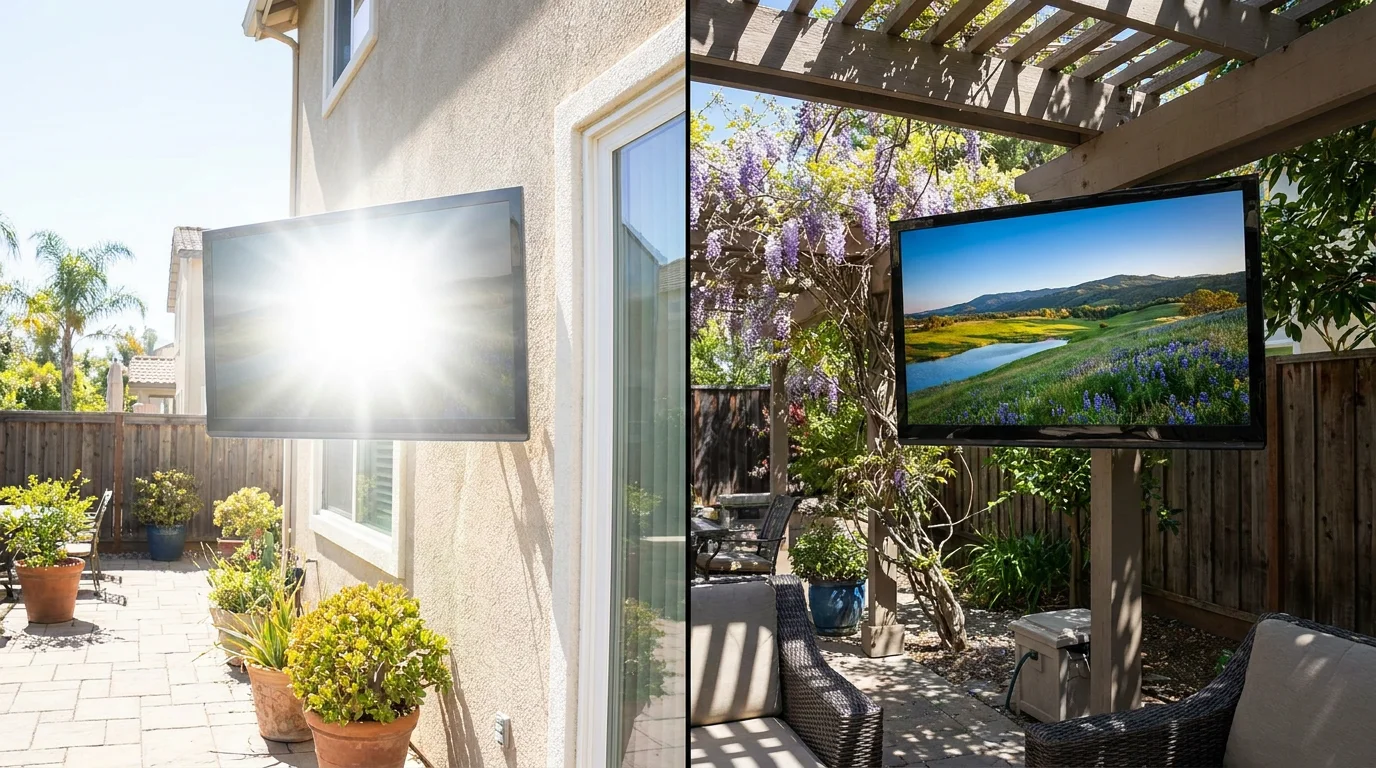
As a general rule: mount the TV on a north-facing or east-facing wall when possible. South and west-facing installations receive direct afternoon sun — the worst glare condition — for the longest duration each day.
Fix 2: Add Shade Over the Viewing Area
A pergola, awning, shade sail, or patio umbrella positioned to shade the TV and the viewer eliminates both types of glare simultaneously. You do not need to shade the entire patio — shading the TV face and a 6-foot cone in front of it is sufficient. This is the most reliable fix for installations where the TV cannot be repositioned (source: thetvshield.com outdoor TV glare guide).
Even partial shade — blocking the sun for the peak glare hours of 11am to 3pm — dramatically improves watchability in afternoon viewing scenarios.
Fix 3: Increase the TV's Brightness
For ambient light overwhelm (not reflection), the right response is more panel brightness, not less ambient light. A TV rated at 800 nits will struggle in partial sun. A panel at 1,500 nits sustains a watchable image in most partial-sun conditions. At 2,500+ nits (peak), direct sun viewing becomes genuinely usable.
If you already own a lower-brightness outdoor TV and are experiencing ambient light washout — not reflection — no amount of shade adjustment will fully solve the problem. In this case, maximizing the TV's brightness setting and enabling any ambient light compensation mode helps somewhat, but there is a hard limit to how much software can compensate for insufficient panel output.
Fix 4: Anti-Glare Screen Film
Anti-glare film reduces specular reflection by scattering reflected light rather than directing it toward the viewer's eyes. The trade-off is a slight reduction in image sharpness and contrast — the matte surface that reduces reflection also diffuses the emitted image slightly.
Anti-glare film is a useful option when repositioning the TV is not possible and shade is not feasible — for example, a fixed-position TV on a south-facing fence in an apartment with no awning options. It is not a first-choice solution for installations where angle or shade adjustments are available, because those adjustments preserve full image quality.
Fix 5: Anti-Reflective Screen Coating (Built-In)
Higher-end outdoor TVs include factory anti-reflective coatings on the panel glass. These work on the same principle as anti-glare film but are integrated at the manufacturer level, which means better optical quality and no adhesive application issues. When evaluating outdoor TV models, look for "anti-reflective glass" or "AR coating" in the specifications — it is a meaningful differentiator at equivalent brightness levels.
What Does Not Fix Glare
Reducing the TV's brightness does not fix glare — it makes the image darker without addressing the light source causing the reflection. Polarizing filters designed for photography are sometimes suggested online; they reduce some types of reflection but cause severe color shift on TV panels and are not a practical solution. And moving seating further from the TV reduces the apparent brightness of the image without addressing the glare source.
Who Will Still Have Glare Problems
If your TV faces due south or west and is fully exposed to afternoon sun with no shade option and cannot be repositioned, you will experience glare regardless of the TV's brightness rating. In this scenario, the practical options are: add shade (the most effective fix), replace the TV with a 2,000+ nit model rated for full-sun use, or accept that midday viewing in that specific installation is not viable. Full-sun outdoor TV installations are genuinely demanding — most outdoor TVs on the market are designed for shade or partial-sun use.
For brightness guidance by installation type, see How Many Nits Does an Outdoor TV Need. For mounting options that give you angle adjustment flexibility, see Do Outdoor TVs Need a Special Mount.

0 comments