

A covered patio changes the math on outdoor TV brightness -- but doesn't eliminate it.
The roof keeps direct rain and overhead sun off the screen. What it doesn't eliminate is ambient light: reflected light from the sky, light bouncing off surrounding surfaces, and low-angle sun that clears the roof edge in the morning or late afternoon. This is the variable most buyers underestimate, and it's the main reason a covered-patio purchase can still go wrong.
The right brightness spec depends on your patio's roof type, orientation, and primary viewing hours -- not just whether it's "covered."
What "Covered" Actually Means for Brightness
Not all covered patios shade equally. Before settling on a brightness target, work through these variables:
Roof type matters more than most buyers realize. A solid roof -- wood, metal, or concrete -- blocks all overhead light and brings ambient conditions closest to true shade. A pergola with open slats allows significant diffuse sky light through gaps; depending on slat spacing, ambient light levels can remain 30-50% of an uncovered space. Shade sails and fabric covers sit somewhere in between, varying by weave density and color.
Orientation determines when and how much low-angle sun reaches the screen. A north-facing covered patio receives minimal direct sun at any point in the day. A south-facing patio will see low-angle morning and late-afternoon sun clear the roof edge, increasing the effective ambient light during those windows. East- and west-facing patios face their strongest exposure during morning and evening respectively -- often the exact hours people use their outdoor space.
Viewing hours are the most overlooked variable. A patio used primarily for evening viewing after sundown has dramatically different requirements than one used for afternoon sports. Identify your actual peak use time before picking a brightness target.
Brightness Thresholds: What the Evidence Says
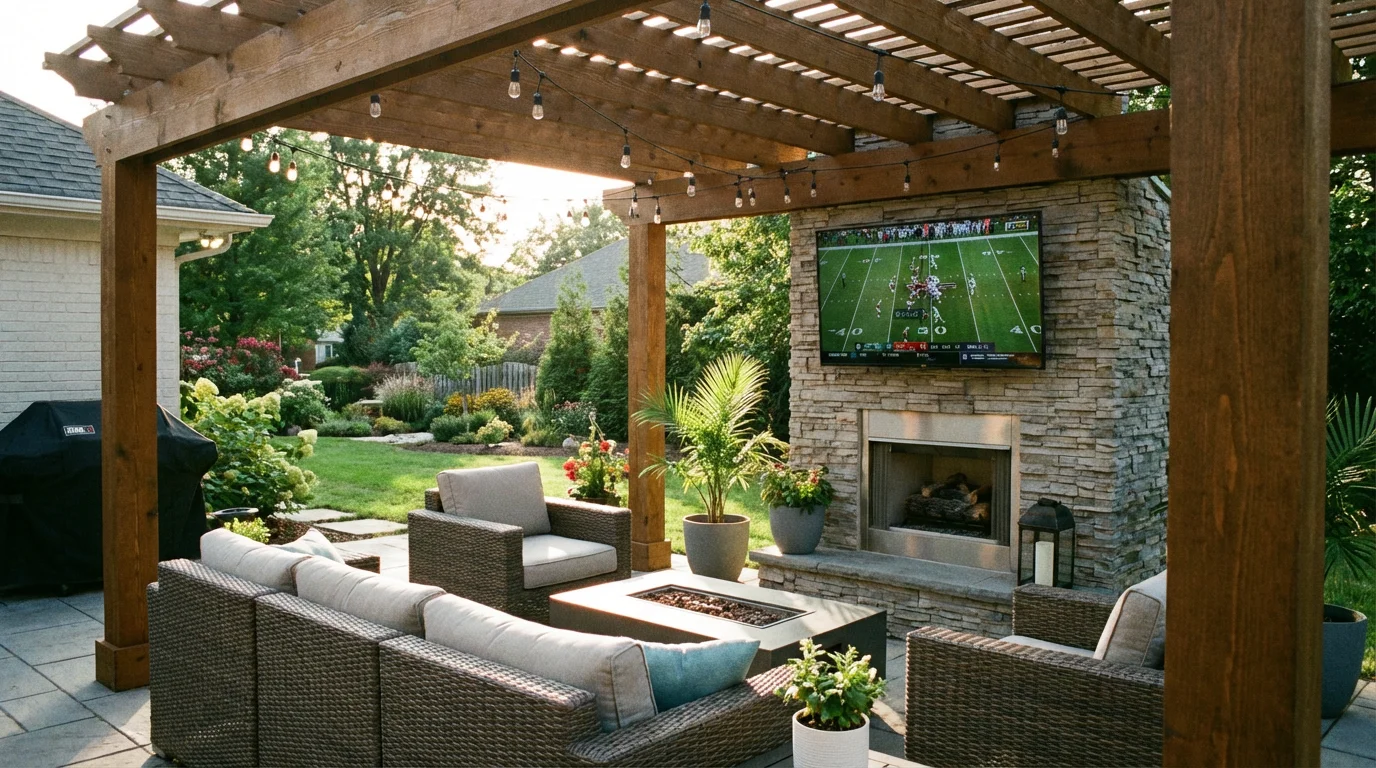
Several independent sources converge on consistent brightness thresholds for covered outdoor installations:
- Full shade / fully covered, evening use: 400-600 nits is typically sufficient. Most ambient light is gone; the main requirement is weatherproofing, not brightness.
- Fully covered, north-facing, daytime use: 700-800 sustained nits. Tvsbook.com's 2026 outdoor TV roundup notes this range as "sufficient" for fully covered or north-facing patios. Esquire's tested review similarly calls 700 nits "a good starting place for partial-sun and full-shade TVs."
- Covered patio with pergola, slats, or south/west-facing orientation: 1,000-1,200 nits. Popular Mechanics (March 2026) recommends "at least 1,000 nits if you plan to put your TV in a covered area" -- the higher end of this range applies when ambient light remains significant through slats or low-angle sun.
- Partially covered with direct sun exposure during viewing hours: 1,500 nits or more. At this point, the "covered" classification may not apply -- treat it as a partial-sun installation.
These are sustained brightness figures. Manufacturer peak brightness numbers -- what most spec sheets advertise -- can run 30-50% higher than sustained brightness. For daytime outdoor use, sustained brightness is the figure that determines real-world visibility. The SunBrite Veranda series, one of the most commonly cited covered-patio recommendations, illustrates this gap: the Veranda 3 is rated at 1,000 nits peak but 600 nits sustained (full-screen). For the full explanation of peak vs. sustained brightness, see the nits guide.
What Else Matters on a Covered Patio
Weatherproofing. A covered patio reduces direct rain exposure -- it doesn't eliminate moisture. Wind-driven rain, morning condensation, and humidity are still regular factors. IP55 is the baseline rating to look for: it covers protection against water jets from any direction, which covers rain and hose-down cleaning. Patios adjacent to a pool add chlorine vapor and splash to the equation; in that case, confirm the specific model's corrosion resistance, not just its IP rating.
Temperature range. Covered patios in cold-winter climates need TVs rated for low storage temperatures, not just low operating temperatures. A TV left mounted through winter needs a storage temperature rating that covers your climate's coldest months. Many purpose-built outdoor TVs specify operating range (e.g., 32 degrees F to 104 degrees F) and a wider storage range (e.g., -22 degrees F to 122 degrees F) -- the storage rating is the one that applies if the TV stays outdoors powered off.
Anti-glare coating. Even in shade, a reflective screen causes eye strain when ambient light is high. Most purpose-built outdoor TVs include matte or anti-glare screen treatments; confirm this for any model you're evaluating, as some entry-level outdoor models omit it.
Audio. A solid covered roof creates some acoustic reflection compared to open air, which modestly reduces the volume required to fill the space. Whether built-in TV speakers are adequate depends on the size of your patio and how much ambient noise (wind, traffic, nearby activity) you're working against -- this is harder to generalize than brightness, and worth testing in person if possible before adding a soundbar.
What to Look for: A Checklist
- Sustained brightness matched to your patio's actual conditions -- use the thresholds above, not just the "outdoor TV" label on the box
- IP55 rating or higher for weather resistance
- Matte or anti-glare screen coating -- confirm it's included, not just assumed
- Operating and storage temperature range covering your local climate extremes
- Built-in smart platform (Google TV, Roku TV, Fire TV) if you don't want to add a separate streaming device outdoors
- VESA mount compatibility with the corrosion-resistant mount you're planning -- verify before purchasing either
If your patio is south- or west-facing with a pergola and you watch during afternoon hours, one option worth evaluating is a TV spec'd at 1,500 nits sustained -- that headroom covers the higher ambient light from low-angle sun clearing the roof edge. The ByteFree 55" Outdoor TV (1,500 nits sustained, IP55, Google TV, -22F to 122F storage range) is one example at the $1,599 price point if that spec range fits your situation.
Who Doesn't Need a High-Brightness Outdoor TV
If your covered patio has a solid roof, faces north or east, and you watch primarily in the evening -- a TV in the 500-700 nit sustained range is likely sufficient. Spending for 1,500 nits in this scenario is unnecessary.
If your patio is a fully enclosed screened room with minimal sky-light exposure and no direct sun reach -- an indoor TV in a quality weatherproof enclosure may be adequate, provided rain and condensation exposure is genuinely low. This is a meaningful cost saving if the conditions truly support it; the risk is underestimating how much ambient light and moisture still reach the screen.
Summary
- "Covered" reduces brightness requirements -- it doesn't eliminate them. Ambient light from sky, surroundings, and low-angle sun still reaches the screen.
- North-facing solid roof: 700-800 sustained nits is typically sufficient (tvsbook.com, Esquire). Pergola or south/west-facing: budget for 1,000-1,200 sustained nits (Popular Mechanics).
- Check sustained brightness on the spec sheet -- not just peak. The gap between the two can be 30-50%.
- IP55 weatherproofing, anti-glare coating, and full temperature range remain important even under cover.
- Evening-only viewers under a solid roof can often target 500-700 nits and save significantly.
For a side-by-side look at how specific outdoor TV models compare on brightness tiers and specs, see the 55-inch outdoor TV comparison. For installation guidance once you've chosen a TV, see how to install an outdoor TV.
FAQ
Do I need a purpose-built outdoor TV for a covered patio, or can I use an indoor TV?
It depends on actual moisture exposure. A fully enclosed patio (screened room, minimal condensation) with genuinely low humidity may be manageable with an indoor TV in a weatherproof enclosure. An open-sided covered patio -- where wind-driven rain, humidity, and morning condensation are regular -- warrants an IP55-rated purpose-built outdoor TV. If you're uncertain, err toward IP55: moisture damage typically isn't covered under warranty for indoor TVs used outdoors.
What size TV works for a typical covered patio?
A common starting point: screen diagonal in inches = viewing distance in inches divided by 1.5. For a 10-foot (120-inch) viewing distance, that suggests roughly 80 inches -- though most residential patios land on 55-65 inches as a practical compromise between visibility, cost, and wall space. Measure your actual primary seating distance before deciding.
Can I leave an outdoor TV mounted year-round under a covered patio?
If the TV's storage temperature rating covers your winter lows, yes -- with a weatherproof cover during extended non-use periods. Check the storage rating specifically, not just the operating range. See how to install an outdoor TV for seasonal maintenance guidance.
Does a covered patio need a UV-resistant mount?
Yes. Even under cover, UV exposure from reflected and diffuse light accelerates corrosion on standard zinc or cadmium-plated hardware. Use stainless steel or hot-dipped galvanized mounting hardware regardless of cover type.

0 comments