

An outdoor TV is exposed to one power threat that indoor TVs largely avoid: nearby lightning strikes and the voltage spikes that travel through outdoor power lines during storms. Whether a surge protector is necessary depends on your installation — but for most permanent outdoor TV setups, it is a straightforward precaution that costs far less than a TV replacement.
Why Outdoor TVs Are More Vulnerable Than Indoor TVs
The risk is not necessarily higher because the TV is outdoors — it is higher because outdoor power circuits are more directly connected to the elements. Exterior outlets are on circuits that may share wiring with outdoor lighting, HVAC compressors, and other equipment connected to longer exterior cable runs. Lightning does not need to strike your house directly to cause damage: a strike within a quarter mile can induce a voltage spike on local power lines that travels into your home's wiring (source: Wirecutter surge protector guide, July 2025).
Additionally, GFCI outlets — which are required on outdoor circuits — protect against ground faults and electrocution but do not protect against voltage spikes. A GFCI and a surge protector serve completely different functions.
What a Surge Protector Actually Does
A surge protector contains a component called a metal oxide varistor (MOV) that absorbs excess voltage above a threshold — typically 120V on a standard US circuit — and diverts it to ground before it reaches your connected device. The key spec is joule rating: the total energy the protector can absorb across its lifetime before the MOV degrades.
- Under 1,000 joules: Adequate for minor spikes; not recommended for high-value electronics
- 1,000 – 2,000 joules: Suitable for most residential outdoor TV installations
- 2,000+ joules: Recommended for areas with frequent storms, older power infrastructure, or rural locations with longer overhead power lines
A surge protector does not protect against a direct lightning strike — nothing at the outlet level does. What it protects against is the far more common indirect surge: line voltage spikes from grid switching, nearby strikes, and power restoration after an outage (source: CNET surge protector guide, January 2026).
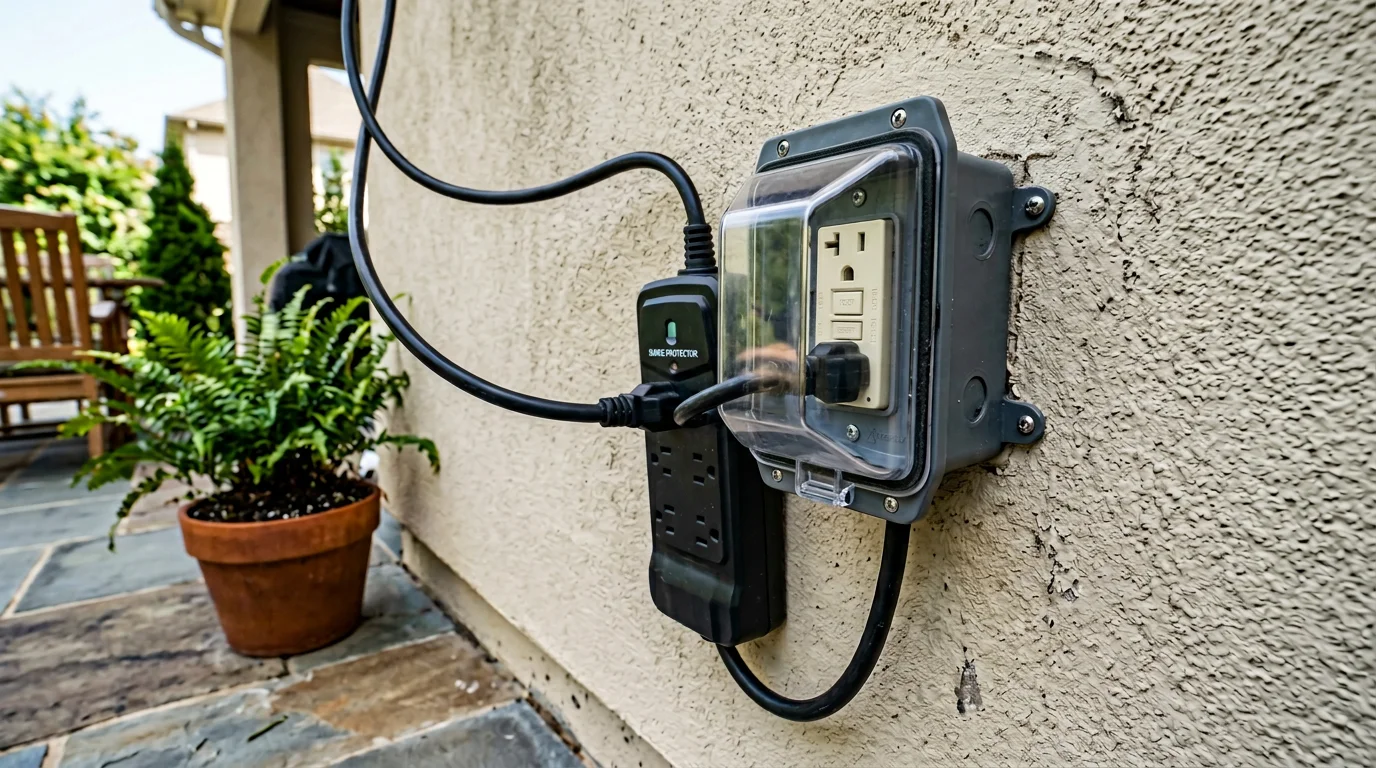
Outdoor-Rated vs. Indoor Surge Protectors
Standard power strip surge protectors are not designed for outdoor use. Outdoor-rated surge protectors have weatherproof enclosures, UV-resistant materials, and sealed outlets that prevent moisture ingress. Using an indoor surge protector in an outdoor installation creates both an electrical safety risk and will degrade quickly from UV and humidity exposure.
Look for outdoor surge protectors with:
- IP44 or higher weather rating
- Grounded (3-prong) outlet design
- Indicator light showing the surge protection MOV is still functional
- UL 1449 certification (the US standard for surge protective devices)
Whole-Home Surge Protection: Worth Considering
A whole-home surge protector installs at your electrical panel and protects every circuit in the house simultaneously — including outdoor circuits. Cost is typically $150 to $400 for the device plus electrician installation. If you have multiple high-value electronics outdoors (TV, outdoor speakers, outdoor refrigerator), the whole-home approach is more cost-effective than individual outlet protectors for each device.
For maximum protection, whole-home surge protection and individual point-of-use surge protectors are complementary — the panel device handles large spikes, the outlet device handles smaller transient surges that pass through the panel protector.
Should You Unplug During Storms?
Unplugging the TV during an electrical storm is the only method that provides complete protection from lightning-induced surges — no surge protector guarantees survival of a nearby direct strike. If severe storms are common in your area and the TV is easily accessible, unplugging during storms is a reasonable practice regardless of what surge protection you have installed.
For TVs mounted at height or in locations where unplugging is inconvenient, a quality surge protector with a high joule rating is the practical alternative.
Who Can Skip the Surge Protector
If your outdoor TV is in a covered, fully enclosed outdoor room connected to a modern home with whole-home surge protection already installed at the panel, an additional point-of-use surge protector is optional rather than essential. Similarly, if you live in an area with underground power lines and rare electrical storms, your surge risk is genuinely lower than average.
That said, a quality outdoor surge protector costs $30 to $80 — a small fraction of the cost of replacing a $1,500 outdoor TV. The math on whether it is worth it is not complicated for most installations.
For the full outdoor TV installation checklist including circuit requirements, see How to Install an Outdoor TV: A Step-by-Step Guide. For power consumption guidance, see Outdoor TV Power Consumption: What to Expect.

0 comments